Featured and Trending
Building High-Performance Teams with Virtual Medical Staffing

“Phones stacked, portal messages pinging, two walk-ins at the window.”
Your front desk has seconds to decide who gets helped first. When that moment happens 500 times a day, you don’t need more chaos, you need a system. That’s the promise of medical front desk outsourcing built on Remote Medical Staffing: a resilient layer of virtual reception, structured phone triage, airtight appointment scheduling, and real intake relief for clinical staff.
What “virtual medical staffing” really means at the front desk
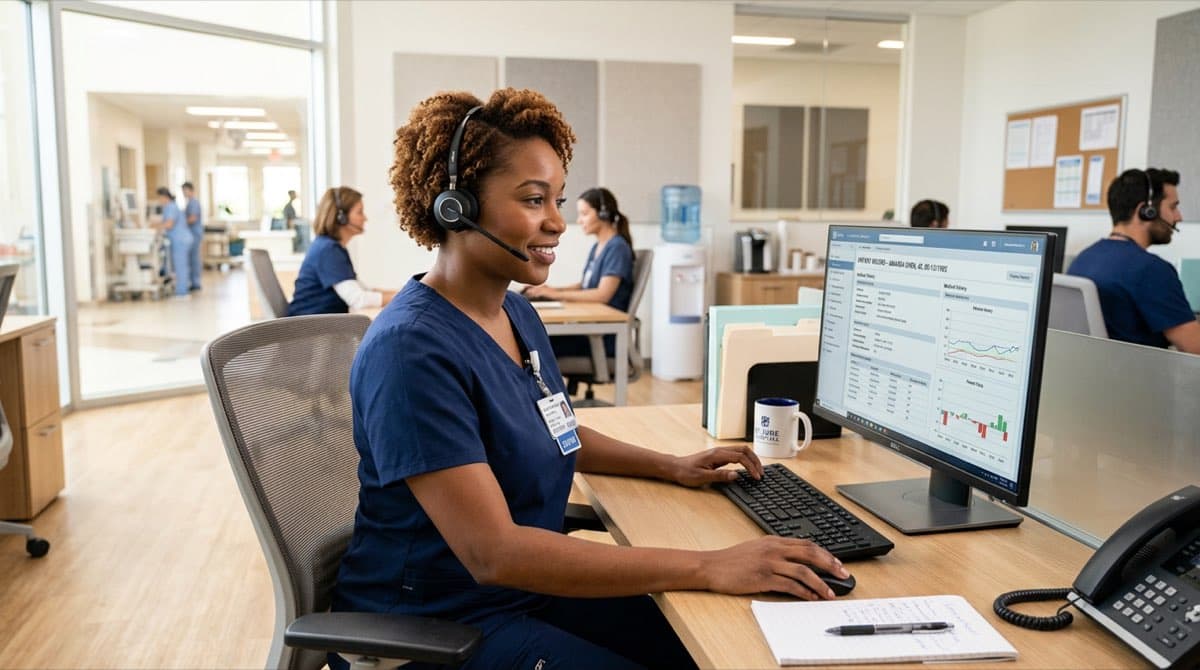
In this model, you extend your team with trained, HIPAA-aware talent that handles call flows, eligibility checks, reminders, and pre-visit work from day one. Done right, virtual reception and phone triage are not a call center, they’re part of your care team’s operating system.
Why this matters for outcomes (not just ops)
When access is hard, patients miss care. No-shows waste scarce capacity and revenue. Recent work in BMJ Open Quality highlights the system-level impact of tackling no-shows with better access and workflow design, not just reminders; see this multi-specialty improvement project on reducing no-shows.
In-house vs. medical front desk outsourcing (with Remote Medical Staffing)
|
What you need most |
In-house only |
Medical front desk outsourcing via Remote Medical Staffing |
|
Virtual reception coverage |
Business hours, back-up is ad-hoc |
Extended hours + surge support, scripted virtual reception |
|
Phone triage |
Nurse/MA interrupted to triage calls |
Dedicated phone triage playbooks, escalation paths |
|
Appointment scheduling |
Manual juggling, limited same-day holds |
Template optimization + appointment scheduling rules, open-access slots |
|
Intake relief |
Front desk splits attention |
Pre-visit forms, benefits checks, and chart prep = true intake relief |
|
Compliance |
Local policies |
HIPAA BAAs, least-privilege access, device hardening |
The mechanics that separate average from excellent
- Virtual reception: Front desks set the tone for the entire visit. Practical playbooks–like MGMA’s guidance on phone-system improvements that lift access–translate directly into better first-contact outcomes when paired with Remote Medical Staffing.
- Phone triage: Structured protocols matter. Evidence syntheses from Cochrane and safety work summarized by the Nuffield Trust show telephone-first designs can redirect demand while maintaining satisfaction, provided escalation is clear and documented.
- Appointment scheduling: Teams that embed the BMC-documented wait-time interventions unlock earlier appointments and reduce leakage. Appointment scheduling rules–bump logic, same-day holds, template hygiene–turn Remote Medical Staffing from “extra hands” into a system.
Quick win: classify every inbound touch into four queues: appointment scheduling, results/questions, refills, and financial, and assign scripts and SLAs per queue. It’s the simplest way to turn virtual reception from reactive to throughput-driven intake relief.
Compliance you can explain to your board
When you choose medical front desk outsourcing, compliance isn’t optional. Every partner that touches PHI must sign a BAA and operate under HIPAA safeguards. Edge bakes compliance into the foundation of our Remote Medical Staffing program:
- Every placement includes a signed BAA between your practice and Edge.
- Assistants are HIPAA-trained and access-scoped to the minimum necessary principle.
- Devices are hardened with encryption, MFA, and audit logging so you have traceability for virtual reception, phone triage, appointment scheduling, and intake relief workflows.
While your compliance team can reference HHS’s sample BAA provisions or CMS/HHS guidance clarifying BAAs, with Edge you don’t have to reinvent the wheel, we deliver HIPAA-aligned, audit-ready frameworks out of the box.
What to measure (so you know it’s working)
- Quality & safety: triage documentation, escalation accuracy, closed-loop messaging—benchmarked against virtual-consultation safety metrics.
- Productivity: bookings/hour, completed appointment scheduling tasks, pre-visit intake relief minutes returned to clinicians
- Role design: BLS profiles help scope skills and training for virtual reception and admin roles.
How Edge builds high-performance front desks
With Edge, medical front desk outsourcing becomes a measurable upgrade to your operating model:
- People: healthcare-trained specialists for virtual reception, phone triage, appointment scheduling, and intake relief, matched by specialty and tools.
- Process: templated appointment scheduling rules (same-day holds, bump logic), phone triage scripts with nurse escalation, and standardized pre-visit checklists for intake relief.
- Platform: HIPAA controls and BAAs aligned with HHS guidance.
Your next step to a high-performance front desk
Other staffing vendors hand you generic assistants and hope they stick. Edge delivers expert, healthcare-trained support in Remote Medical Staffing that’s measurable, compliant, and tailored to your practice. That’s the real difference.
Book a demo with us today to explore how your practice can turn admin bottlenecks into high-performance workflows.
More from Medical

Virtual Front Desk for Medical Offices: Cost Guide
If you’ve already read what a virtual front desk covers, the next question is more practical: how does it actually get billed, set up, and connected to the systems your practice already runs. Most vendor pages skip straight to a number. The number matters less than the structure behind it, and the structure is where …
HIPAA Compliant Answering Service: What to Know
Most practices think their answering service meets HIPAA requirements once the vendor signs a Business Associate Agreement (BAA). However, the agreement alone doesn’t protect patient information. It doesn’t encrypt messages, train staff, or ensure agents understand medical calls. Practices that rely on paperwork alone may discover these gaps when a routine after-hours call goes wrong. …

What Is a Virtual Medical Receptionist? A Complete Guide for Practice Owners
A virtual medical receptionist is a HIPAA-trained professional who handles a practice’s phones, scheduling, and patient intake from outside the physical office, working inside the practice’s own EHR and phone system. The work is the same as an in-house front desk role: answering calls, booking and confirming appointments, verifying insurance, and routing messages to the …

Healthcare Administrative Capacity Crisis: Why Care Delivery Is Slowing
For years, operational strain in healthcare has been framed as a staffing shortage. But the data points to something deeper: a healthcare administrative capacity crisis. Organizations are being asked to reduce staffing while administrative workload continues to rise, creating a widening gap between the work that must get done and the capacity available to execute …