Featured and Trending
Healthcare Admin Systems in a Post-Shortage Era

For years, the labor crisis in healthcare has focused almost exclusively on clinical staffing. But there’s another breakdown quietly unfolding behind the scenes, one that touches every patient interaction, every dollar billed, and every record managed.
Administrative teams are in trouble.
These roles, often viewed as peripheral, are now at the center of operational risk. Schedulers, claims processors, and compliance coordinators are in short supply. And the systems built to support them haven’t adapted. In our new industry report, The Future of Admin Work in Healthcare, we explore how outdated hiring practices and limited local talent pools are putting revenue, compliance, and patient experience at risk.
Admin labor is swallowing up budgets
According to our research, the average U.S. healthcare practice now spends over 30% of its revenue managing administrative tasks.
Nearly a third of every patient dollar is going toward back-office coordination, billing, insurance claims, and data entry.
This combination of high spend and low retention is leaving many healthcare leaders stuck. They can’t scale operations, improve efficiency, or meaningfully reinvest in patient care because the admin engine behind their practices is running on fumes.
The real shortage is happening at the front desk
Much of the national conversation around healthcare labor focuses on nursing and physician burnout. And while that concern is valid, our findings suggest that administrative teams may be under even more structural pressure.
Without strong administrative staffing, clinical teams struggle to stay productive. Schedulers can’t keep calendars full. Billers fall behind on claims. Compliance coordinators miss critical updates. It’s not just a staffing problem, it’s a systems problem.
What’s worse: the local pipeline isn’t keeping up. Many markets simply don’t have a deep enough bench of HIPAA-trained, experienced administrative professionals to meet growing demand.
A new model is gaining traction
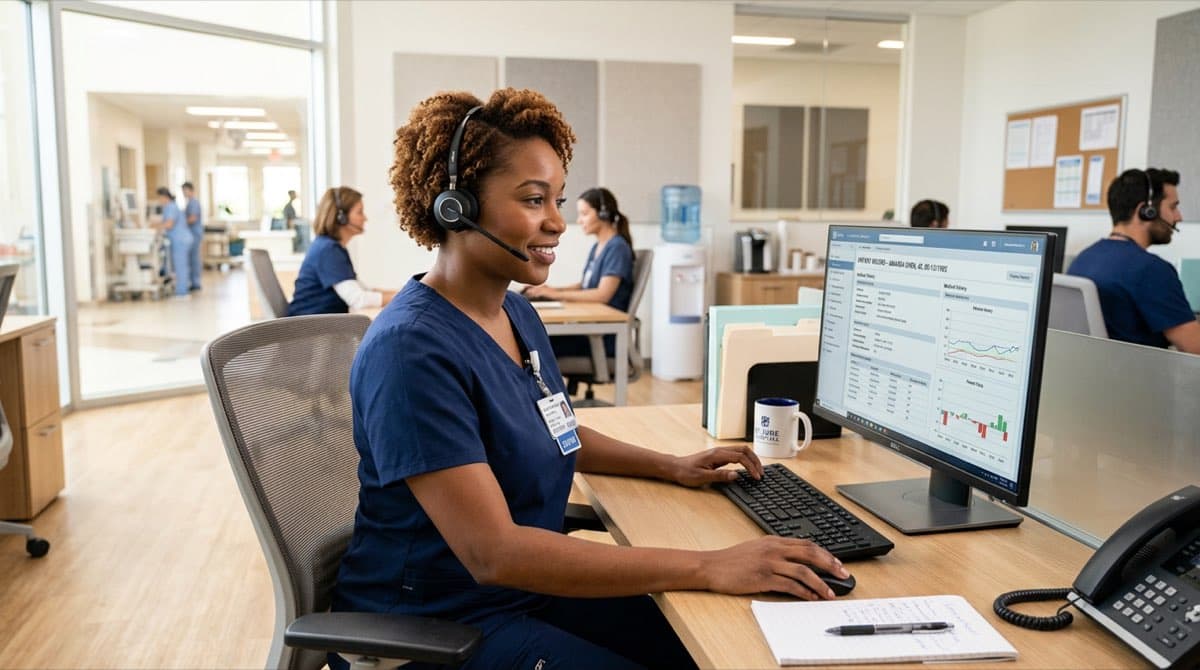
More and more healthcare organizations are turning to remote-first, globally sourced admin teams to stabilize operations and lower costs. Our research shows why.
82% of Edge’s global talent pool is willing to complete HIPAA and SOC 2 certifications, more than double the percentage of U.S.-based applicants.
Our research captures measurable gains from practices that are already adapting and thriving.
As Iffi Wahla, CEO and co-founder of Edge, puts it, “The real risk isn’t remote work, it’s clinging to outdated assumptions about where and how this work should get done.”
Forward-thinking providers are choosing to break that pattern. They’re reframing admin work as critical infrastructure, not an afterthought. And they’re tapping into a global workforce ready to work, train, and grow.
Get the full picture
Edge’s new report goes deeper into these findings, with data from healthcare leaders, real staffing benchmarks, and emerging models for operational efficiency.
Unlock Your FREE Industry Report
More from Medical

Virtual Front Desk for Medical Offices: Cost Guide
If you’ve already read what a virtual front desk covers, the next question is more practical: how does it actually get billed, set up, and connected to the systems your practice already runs. Most vendor pages skip straight to a number. The number matters less than the structure behind it, and the structure is where …
HIPAA Compliant Answering Service: What to Know
Most practices think their answering service meets HIPAA requirements once the vendor signs a Business Associate Agreement (BAA). However, the agreement alone doesn’t protect patient information. It doesn’t encrypt messages, train staff, or ensure agents understand medical calls. Practices that rely on paperwork alone may discover these gaps when a routine after-hours call goes wrong. …

What Is a Virtual Medical Receptionist? A Complete Guide for Practice Owners
A virtual medical receptionist is a HIPAA-trained professional who handles a practice’s phones, scheduling, and patient intake from outside the physical office, working inside the practice’s own EHR and phone system. The work is the same as an in-house front desk role: answering calls, booking and confirming appointments, verifying insurance, and routing messages to the …

Healthcare Administrative Capacity Crisis: Why Care Delivery Is Slowing
For years, operational strain in healthcare has been framed as a staffing shortage. But the data points to something deeper: a healthcare administrative capacity crisis. Organizations are being asked to reduce staffing while administrative workload continues to rise, creating a widening gap between the work that must get done and the capacity available to execute …